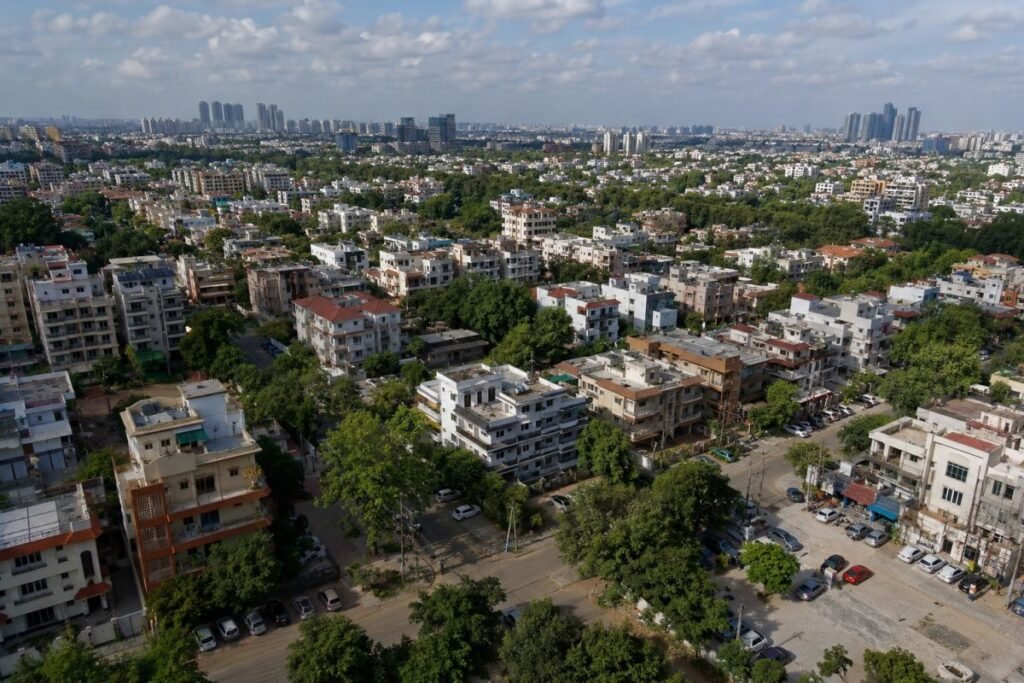
Properties in Sector 40 Gurugram sit in one of the more established residential pockets of central Gurugram. Unlike newer corridors where buyers are largely betting on future infrastructure, Sector 40 offers an existing neighbourhood, established housing stock, access to employment hubs and proximity to major roads.
The market is also different from a typical high-rise apartment market. Independent floors, builder floors, plotted homes and resale properties form a significant part of the available inventory, while newer floor developments provide a more modern product within an established location.
For buyers comparing Sector 40 Gurugram properties, the main question is therefore not simply whether the sector is expensive or affordable. It is whether the specific property justifies its land component, construction quality, location within the sector and resale potential.
Sector 40 Gurugram Property Market at a Glance
Sector 40 is positioned between established residential areas such as Sectors 31, sector 41, sector 45 and sector 46, with South City 1 and Greenwood City adding to the surrounding residential ecosystem.

Current market listings show a wide spread in asking prices because properties vary substantially in land share, built-up area, age, construction quality and plot position. Publicly visible September 2026 listings also show that the sector has both conventional resale inventory and newer independent-floor offerings.
| Factor | Sector 40 Market |
|---|---|
| Market character | Established residential |
| Dominant property types | Builder floors, independent floors, houses and resale homes |
| Typical buyer | End-user, upgrade buyer, long-term investor |
| Market maturity | Mature |
| Rental potential | Supported by established employment catchments |
| Key advantage | Central location and existing ecosystem |
| Main risk | Property-to-property quality variation |
The sector’s established character is important. Buyers are not purchasing only an apartment; in many cases, they are buying an interest in a developed residential plot and the neighbourhood around it.
Property Prices in Sector 40 Gurugram
There is no single “Sector 40 Gurugram price” because the market is highly heterogeneous.
Current listing data shows a broad range of asking rates, with premium independent floors and larger homes commanding substantially more than older or smaller properties. One market dataset places the average asking rate at approximately ₹27,340 per sq. ft., while another shows a substantially different average because of the mix of properties included. This variation itself is a useful warning: headline locality averages should not be used to value an individual Sector 40 Gurugram property.
For a buyer, valuation should instead be based on:
- Plot size and the property’s land share
- Floor area and efficiency of the layout
- Age of construction
- Parking arrangement
- Floor level and terrace rights
- Road width and approach
- Construction quality
- Documentation and title history
- Renovation requirement
- Recent comparable transactions or credible asking prices
A ₹3 crore floor and a ₹3 crore independent house in the same sector can represent very different investments.

What Buyers Should Expect
The current inventory includes everything from relatively compact flats to large premium floors and independent houses. Public listings also show ready-to-move inventory, which makes Sector 40 Gurugram particularly relevant for buyers who do not want to take several years of construction or possession risk.
For investors, however, a high asking price does not automatically mean strong investment value. The land component, achievable rent and future resale liquidity matter more than the quoted price per square foot alone.
Flats in Sector 40 Gurugram: What Is Available?
Flats in Sector 40 Gurugram are not as uniform as those in a large master-planned high-rise society.
The locality has a mixture of older residential developments, builder floors, independent floors and resale apartments. This gives buyers more choice in terms of configuration and budget, but it also makes due diligence more important.
For an end-user, the attraction is straightforward: an established residential environment without having to wait for a new township to mature.
For investors, the calculation is different. Older properties can sometimes offer better entry points relative to newer premium floors, but maintenance, construction age and tenant profile need to be assessed carefully.
Live Projects and New Development in Sector 40 Gurugram
Sector 40 Gurugram is primarily a mature residential market rather than a large-scale new-launch corridor.
Current market inventory includes newer independent-floor developments alongside established resale housing. For example, Sunder Luxury Floors is currently marketed as a 4 BHK residential offering in Sector 40 Gurugram, with publicly listed pricing around ₹3.78 crore. The project is shown as a newer floor development rather than a conventional large gated high-rise community.

The distinction matters.
A buyer searching for a “new project” in Sector 40 should not assume that every new listing represents a large developer-led township. Much of the new supply is in the independent-floor segment.
RERA status, sanctioned plans, completion documentation and title records should be checked against the exact property and promoter before making any payment. Sector-level references are not sufficient because similarly named projects can appear in different Haryana districts. The official RERA database, for example, contains several unrelated projects carrying “Sector 40” in their addresses.
Why Buyers Consider Sector 40 Gurugram
1. Established Central Gurugram Location
Sector 40 Gurugram benefits from being surrounded by mature residential and commercial development rather than sitting at the edge of the city’s expansion.
It is reasonably positioned for access towards Sohna Road, NH-8, central Gurgaon and employment areas around the older business districts.
2. Existing Social Infrastructure
Schools, healthcare facilities, daily retail and neighbourhood services are already present around the wider Sector 40–41–45 belt.
That reduces one of the common risks associated with buying in a developing sector: having to wait for basic urban infrastructure to catch up with housing supply.
3. Multiple Property Formats
Buyers can compare apartments, builder floors, independent floors and larger homes rather than being restricted to one housing format.
This is particularly useful for families moving up from apartments who want additional floor area or greater privacy.
4. Rental and Resale Use Case
Sector 40 Gurugram‘s established location gives it an existing tenant and end-user base. However, rental yield should be calculated property by property rather than inferred from the locality’s capital value.
A premium floor purchased at a high valuation may generate a lower yield than an older, more moderately priced property.
Sector 40 Gurugram vs New Gurgaon Corridors
Sector 40 and newer Gurgaon corridors represent different investment propositions.
| Factor | Sector 40 | Newer Gurgaon Corridors |
|---|---|---|
| Development stage | Mature | Developing |
| Existing infrastructure | Strong | Varies |
| New supply | Limited and fragmented | Higher |
| Property formats | Floors, houses, resale apartments | High-rise, plotted and mixed formats |
| Possession risk | Lower for ready homes | Higher for under-construction assets |
| Land component | Important | Depends on project |
| Appreciation thesis | Location maturity + scarcity | Infrastructure + future development |
A buyer prioritising immediate usability may prefer the established ecosystem of Sector 40. Someone willing to accept development risk may instead compare it with emerging areas around Dwarka Expressway, SPR or New Gurugram.
The comparison should ultimately be based on the buyer’s holding period, budget, intended use and tolerance for construction risk.
Connectivity: How Well Is Sector 40 Gurugram Connected?
Sector 40 benefits from its central position within Gurgaon.

The road network provides access towards NH-8, Sohna Road and the wider central Gurgaon road system. Nearby established sectors also connect the locality with commercial and employment destinations.
Metro access is another consideration. The Millennium City Centre Gurugram metro station and surrounding public-transport network improve accessibility for residents who work in established parts of Gurgaon and Delhi-NCR.
For airport-dependent professionals, IGI Airport remains accessible through the broader Gurgaon road network, although actual travel time can vary considerably with traffic.
The important point is that Sector 40’s connectivity advantage comes from its established position rather than from one single upcoming infrastructure project.
Who Should Buy Property in Sector 40?
Sector 40 can make sense for:
- Families looking for an established neighbourhood
- Buyers upgrading from smaller apartments
- Professionals working in central Gurgaon
- End-users wanting ready-to-use residential infrastructure
- Investors focused on established rather than speculative locations
- Buyers interested in independent floors and land-backed residential formats
It may be less suitable for buyers whose primary objective is to enter at a low ticket size and capture appreciation from a completely new infrastructure corridor.
What to Check Before Buying
The biggest mistake in Sector 40 is treating all properties as comparable.
Before finalising a purchase, check:
- Title and ownership: Verify the ownership chain and seller’s authority to sell.
- Sanctioned plan: Ensure the actual construction corresponds with approved plans.
- Land share: Understand exactly what proportion of the underlying land is attached to the property.
- Floor rights: Confirm terrace, parking and common-area rights in writing.
- Construction quality: Inspect structure, waterproofing, electrical work and plumbing.
- Approvals: Check applicable completion, occupation and other statutory documentation.
- Encumbrances: Confirm that the property is free from undisclosed loans, claims or disputes.
- Market valuation: Compare multiple genuinely comparable properties rather than relying on locality-wide averages.
- Rental economics: Calculate achievable rent against the complete acquisition cost.
- Exit liquidity: Consider how easily the property could be sold five to seven years later.
This level of diligence is particularly important for independent floors because the physical product can vary significantly from one property to another.
Is Sector 40 a Good Place to Buy Property?
Sector 40’s investment case is based more on established location, usable infrastructure and residential scarcity than on a dramatic future-development story.
Its strongest proposition is for buyers who value central Gurgaon access, an existing neighbourhood and ready or near-ready residential options.
The weakness is equally clear: the market is fragmented. Two properties within the same sector can have very different construction quality, land economics, documentation and resale prospects.
The practical verdict is therefore property-specific. A well-documented floor or house at a sensible valuation can be materially different from an overpriced property simply because it carries a Sector 40 address.
For buyers evaluating the sector, compare the exact property against recent alternatives in nearby Sectors 31, 41, 45 and 46 before committing capital.
Final Takeaway
Properties in Sector 40 are best understood as established Gurgaon residential assets rather than conventional new-project inventory.
The sector offers central positioning, mature infrastructure and a broad mix of homes, but its fragmented property stock means due diligence is more important than relying on a single price-per-square-foot figure.
If you are comparing a specific floor, house or resale apartment, assess the land share, title, construction quality, asking price, rental potential and exit liquidity together. That gives a much clearer investment picture than the locality name alone.
For a deeper evaluation, explore the relevant Sector 40 property listings and project information on AssetBulls, or speak with the advisory team before shortlisting a property.
Frequently Asked Questions
Are properties in Sector 40 Gurugram expensive?
Properties in Sector 40 cover a wide price spectrum because the market includes builder floors, independent houses, resale apartments and larger premium homes. The exact value depends heavily on land share, construction quality, size, location within the sector and documentation.
What is the price of flats in Sector 40 Gurugram?
There is no reliable single price for all flats in Sector 40. Current market listings show substantial variation in asking rates, so buyers should compare properties with similar configuration, age, floor area and land component rather than using one locality-wide average.
Are there new projects in Sector 40 Gurgaon?
Yes, newer independent-floor developments are marketed in Sector 40, although the locality is predominantly an established residential market rather than a large new high-rise development corridor. Current listings include newer floor projects alongside extensive resale inventory.
Is Sector 40 Gurgaon good for investment?
Sector 40 can suit investors who prioritise an established residential location, existing infrastructure and potential resale liquidity. The investment case is highly property-specific, however, so title, land share, purchase price, rent and future exit demand should be evaluated before buying.
What should I check before buying a property in Sector 40?
Check title ownership, sanctioned plans, land share, parking and terrace rights, construction quality, applicable approvals, outstanding loans or claims and the property’s realistic market value. For any claimed RERA-registered project, verify the exact project and registration details against the official Haryana RERA record before making a payment.