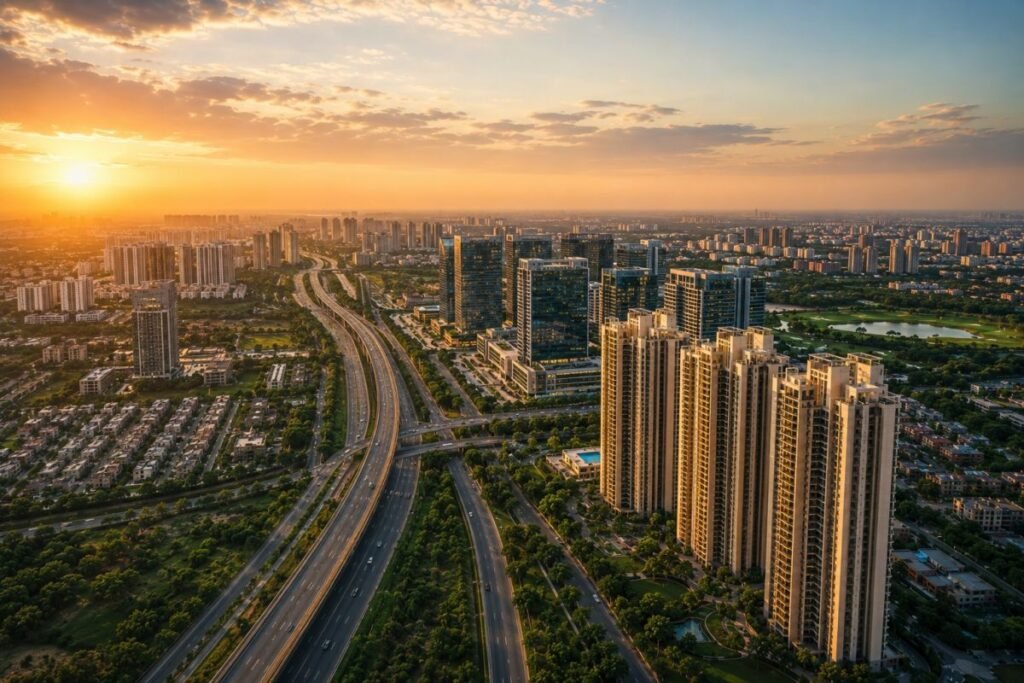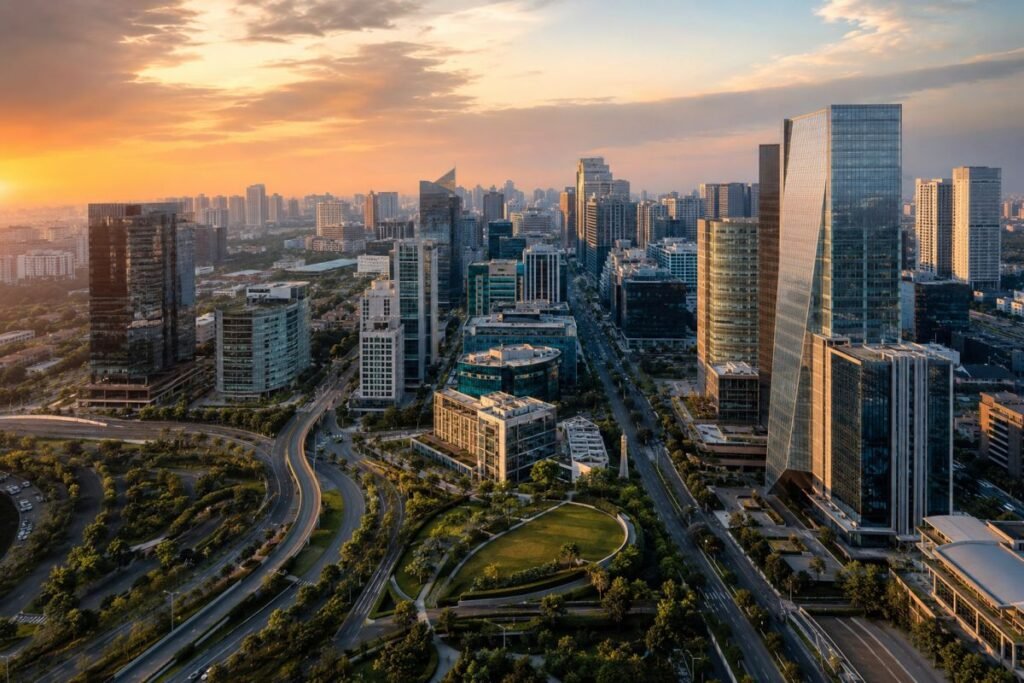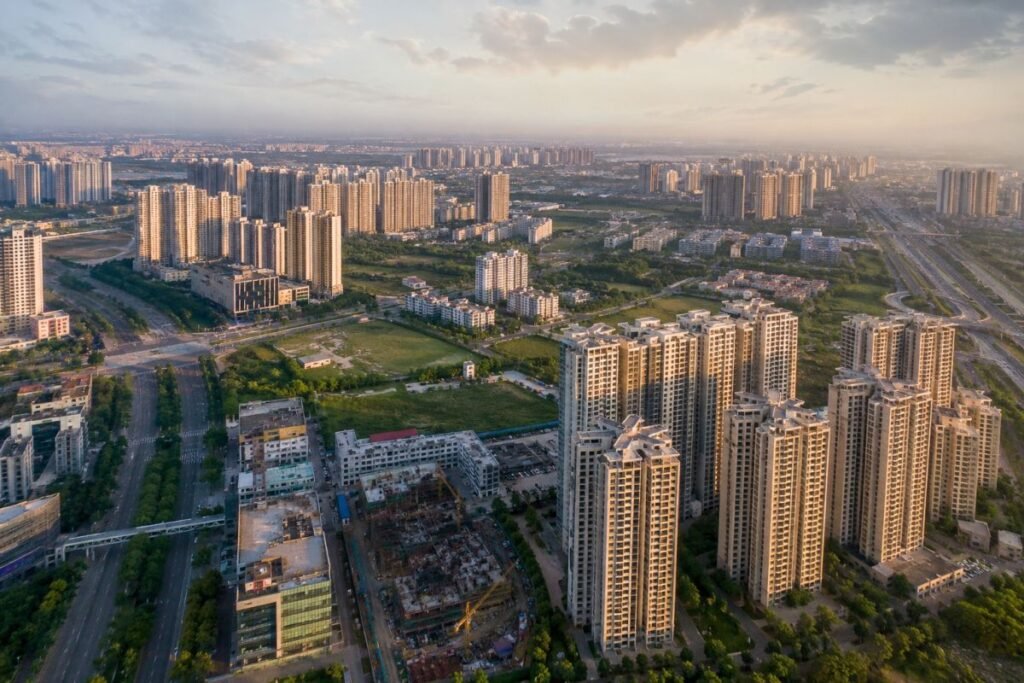
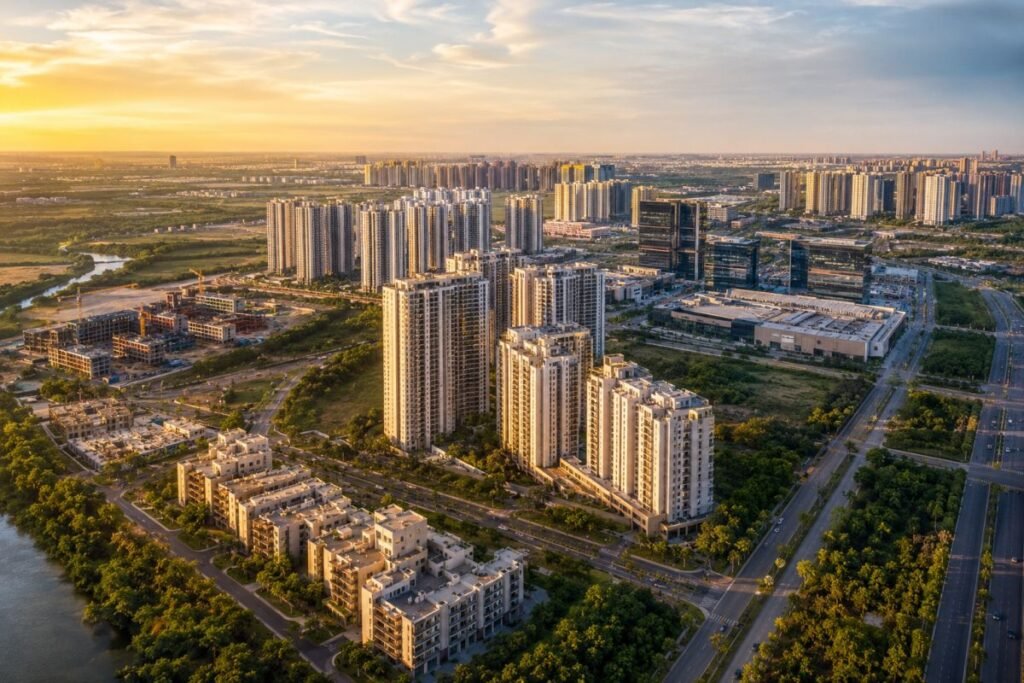
New Gurugram is no longer the “next frontier” of the National Capital Region — it is the frontier. Over the past five years, this western stretch of Gurgaon has transformed from a patchwork of agricultural land and sporadic development into one of the most actively transacted residential corridors in the Delhi-NCR. If you are evaluating projects on new gurugram for end-use or portfolio allocation, understanding the corridor’s anatomy, price architecture, and builder ecosystem is essential before committing capital.
This guide breaks down what New Gurugram actually covers, why it matters, how it connects to the rest of the NCR, what you will pay, and which developments are worth tracking.
What Is New Gurugram? Defining the Corridor
“New Gurugram” is not an official municipal designation. In market parlance, it refers to the sectors and townships developing along the western and south-western periphery of Gurgaon, primarily beyond the established residential clusters of the old city. The corridor broadly spans sectors along the Dwarka Expressway (Northern Peripheral Road), the Southern Peripheral Road (SPR), and the emerging micro-markets feeding off NH-8’s western alignment.
Key sectors typically associated with New Gurugram include Sector 82, 83, 84, 85, 86, 88A, 89A, 90, 92, 95, and the larger township developments around Manesar and Pataudi Road. The area is characterised by:
- Large, contiguous land parcels enabling integrated township development
- Relatively lower population density compared to central Gurugram
- Aggressive infrastructure rollout by HUDA (now GMDA) and private developers
- A price band that sits 20–40% below comparable inventory in Golf Course Extension Road or Sohna Road
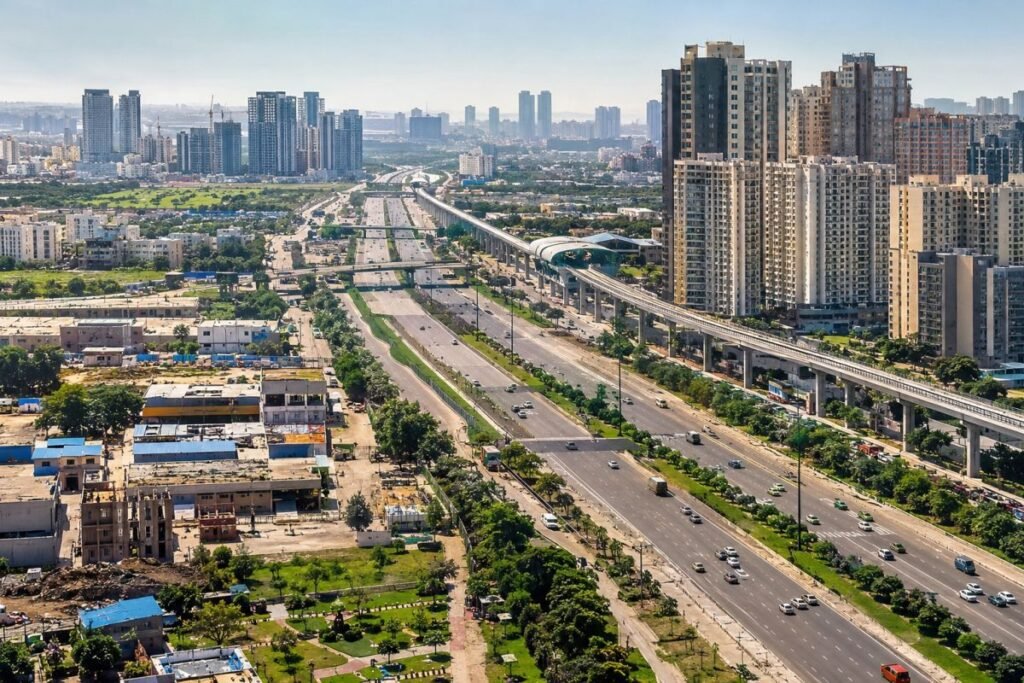
The corridor’s growth is fundamentally tied to two infrastructure narratives: the completion of the Dwarka Expressway and the gradual westward shift of commercial and industrial activity from IMT Manesar toward the Delhi border.
Connectivity: The Infrastructure Backbone
No locality guide is useful without a clear read on how people and goods move. New Gurugram’s investment case rests heavily on its multi-modal connectivity profile.
Road Networks
NH-8 (Delhi-Jaipur Highway): The primary arterial. Sectors along the western side of NH-8 (Sector 82 onwards) benefit from direct highway access, though peak-hour congestion at Hero Honda Chowk and Rajiv Chowk remains a friction point. The ongoing underpass and flyover projects are intended to de-bottleneck these intersections.
Dwarka Expressway (Northern Peripheral Road): A 29-km eight-lane expressway connecting Shiv Murti in Delhi to Kherki Daula in Gurgaon. Sections are operational; full completion has been pending for years but recent progress suggests the remaining stretches are advancing. Once fully operational, this will reduce travel time to IGI Airport to approximately 20–25 minutes from key New Gurugram sectors.
Southern Peripheral Road (SPR): Connects NH-8 near Vatika Chowk to Sohna Road and further to the Golf Course Extension Road. For residents in southern New Gurugram sectors, SPR provides an alternative east-west route that bypasses central Gurgaon traffic.
Pataudi Road: An emerging secondary corridor linking Sector 84–86 clusters to Pataudi town and the wider Rewari district. Currently a two-lane road with expansion plans; it serves local connectivity rather than NCR-level transit.
Metro and Rail
The Delhi Metro’s Yellow Line terminates at Samaypur Badli and does not directly serve New Gurugram. The proposed Metro Phase 4 extension and Rapid Rail Transit System (RRTS) corridors include alignments that would connect the Dwarka Expressway belt to Delhi’s metro network, but timelines remain uncertain. [verify: current status of RRTS Phase 2 alignment through New Gurugram sectors]
For now, metro access for New Gurugram residents typically involves a 15–20 minute drive to HUDA City Centre or IFFCO Chowk stations.
Airport Access
IGI Airport is approximately 25–35 km from most New Gurugram sectors, depending on exact location and route. The Dwarka Expressway, once fully operational, will be the fastest corridor. Currently, NH-8 via Mahipalpur or the Delhi-Gurgaon Expressway are the standard routes, with typical travel times of 45–75 minutes during peak hours.
Real Estate Landscape: Projects and Developers
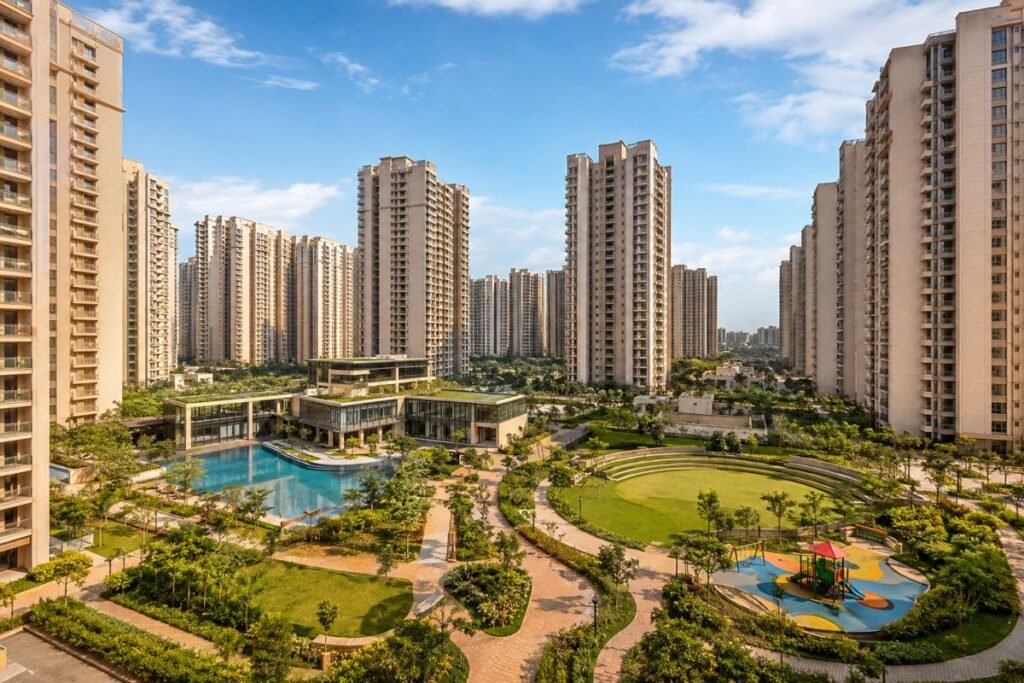
New Gurugram’s residential market is dominated by mid-to-large-scale township developments from Tier-1 and Tier-2 builders. The product mix skews heavily toward 2BHK and 3BHK apartments, with increasing supply of 4BHK and luxury configurations as the market matures.
Key Developers Active in the Corridor
- DLF: Present through plotted developments and township components in the broader western Gurgaon belt
- Vatika: Multiple projects across Sector 82, 83, and 84; known for integrated township models with commercial and institutional components
- Bestech: Active in Sector 81 and adjacent areas with mid-premium residential offerings
- Tata Housing / Shapoorji Pallonji: Select projects bringing branded development standards
- Local and regional builders: Numerous smaller developers with projects in Sector 88A, 89A, 90, and 92; due diligence on delivery track record is critical
Typology and Unit Sizes
| Configuration | Typical Super Area (sq ft) | Target Buyer Profile |
|---|---|---|
| 2 BHK | 1,100 – 1,400 | First-time buyers, young professionals |
| 3 BHK | 1,600 – 2,200 | Upgrade buyers, nuclear families |
| 3 BHK + Study | 2,000 – 2,500 | Professionals needing home office space |
| 4 BHK / Luxury | 2,400 – 3,500+ | HNIs, extended families, investors |
| Plotted Development | 200 – 500 sq yards | End-users seeking custom construction |
The corridor has seen a notable shift from pure apartment stock to mixed-use townships that include retail high streets, school plots, and green buffers. This township model reduces dependency on central Gurgaon for daily amenities and supports long-term capital appreciation.
Price Analysis: Current Trends and Trajectory
Pricing in New Gurugram is not uniform. It varies significantly by exact sector, builder brand, project stage, and proximity to operational infrastructure.
Price Bands by Micro-Market (Approximate, 2026)
| Micro-Market | Price Range (per sq ft) | Premium Drivers |
|---|---|---|
| Sector 82–83 (NH-8 side) | ₹7,500 – ₹9,500 | Established social infra, metro-adjacent potential |
| Sector 84–86 (Central New Gurugram) | ₹6,500 – ₹8,500 | Large townships, balanced supply-demand |
| Sector 88A–89A–90 | ₹5,500 – ₹7,500 | Emerging supply, lower entry point |
| Dwarka Expressway adj. sectors | ₹8,000 – ₹11,000 | Premium connectivity, airport proximity |
| Manesar extension / Pataudi Road | ₹4,500 – ₹6,500 | Industrial adjacency, speculative play |
Rental Yield Context
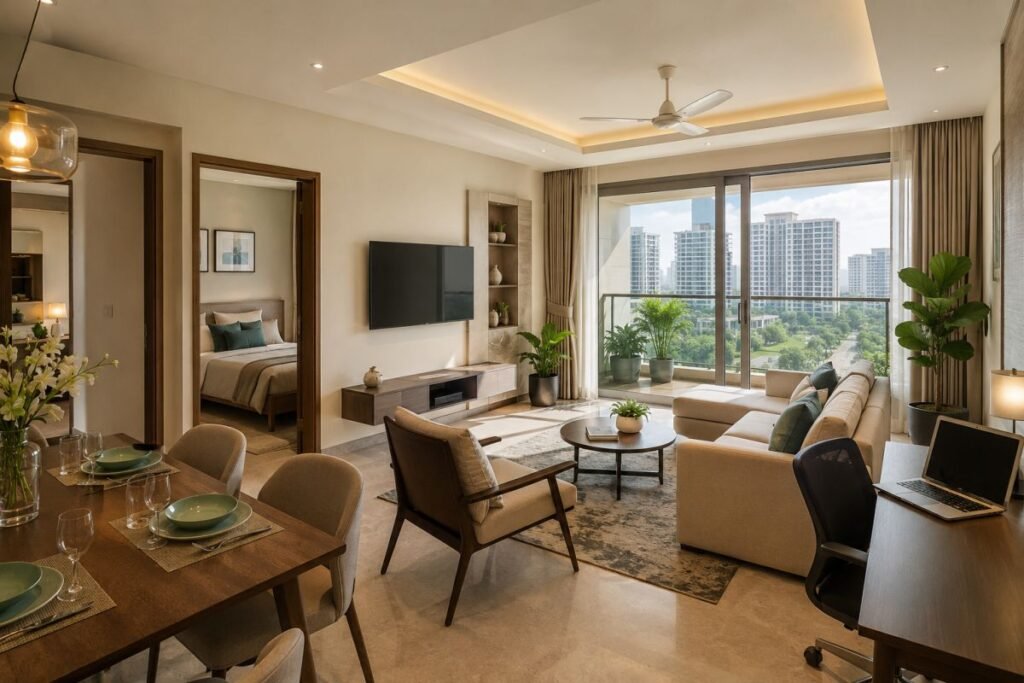
Rental yields in New Gurugram typically range between 2.5% and 3.5% annually, slightly below central Gurugram’s 3.0–4.0% but with a lower capital entry point. The tenant pool comprises:
- Employees of IMT Manesar and nearby industrial units
- IT professionals working in Sector 74–75 and Udyog Vihar (willing to commute for lower rents)
- Airport and aviation sector staff
Price Appreciation Drivers
- Dwarka Expressway completion: The single biggest catalyst. Historical data from other NCR corridors suggests 15–25% capital appreciation in the 12–18 months following major infrastructure commissioning.
- Commercial absorption: As office stock expands along NH-8 and SPR, residential demand follows. Track leasing activity in nearby commercial developments.
- GMDA infrastructure: Road widening, sewage treatment capacity, and power grid upgrades in sectors 82–92.
- Builder consolidation: Delivery of stalled projects and entry of branded developers improves buyer confidence and pricing power.
Investment Potential: Who Should Consider New Gurugram?
New Gurugram is not a universal recommendation. Its risk-return profile suits specific investor and end-user profiles.
Strengths
- Lower entry price: 20–40% discount to Golf Course Extension Road and Sohna Road for comparable specifications
- Infrastructure upside: Dwarka Expressway and SPR improvements are binary events with significant valuation impact
- Supply pipeline: Sufficient inventory to allow selective buying; not a seller’s market yet
- End-user demand foundation: Industrial and commercial employment centres within 10–15 km create genuine rental demand
Weaknesses and Risks
- Delivery risk: Several projects, particularly from smaller builders, have faced delays. RERA has improved accountability but execution risk remains
- Infrastructure uncertainty: Dwarka Expressway has missed multiple deadlines. Betting on its completion requires patience
- Social infrastructure gaps: Premium healthcare, retail, and schooling options are thinner than in central Gurugram; residents often commute for specialised services
- Liquidity: Resale markets are less active than in established Gurugram sectors. Exit timelines can be 6–12 months longer
Investor Profile Match
| Profile | Suitability | Rationale |
|---|---|---|
| Long-term investor (5–7 years) | Strong fit | Time horizon aligns with infrastructure payoff |
| First-time homebuyer | Moderate fit | Affordable entry, but verify builder RERA status and project progress |
| Rental yield seeker | Weak fit | Yields are modest; central Gurugram or Noida Expressway offer better cash flow |
| Speculative short-term | Poor fit | Price discovery is ongoing; liquidity constraints make quick exits difficult |
Key Projects to Track
While specific project recommendations require individual due diligence, the following categories of flats on new gurugram merit attention based on builder track record, location fundamentals, and construction progress:
- Integrated townships in Sector 82–84: These offer the most complete living ecosystem with internal retail, schools, and green spaces. Look for projects with >50% construction completion and valid RERA registration.
- Dwarka Expressway-facing developments: Premium locations with the highest appreciation potential, but verify actual distance from the expressway alignment — “facing” is often a marketing term.
- Sector 88A–90 mid-segment projects: Best price-to-space ratio for end-users prioritising unit size over brand prestige. Critical to assess builder financial health.
Regulatory and Due Diligence Checklist
Before committing to any projects on new gurugram, verify:
- RERA registration: All projects must be registered with Haryana RERA. Check the registration number on the official portal.
- Land title clarity: New Gurugram has seen litigation around land acquisition and zoning. Request title search reports for projects on the periphery.
- Builder delivery track record: Visit completed projects by the same developer. Do not rely solely on marketing materials.
- Approved layout plans: Ensure the unit you are buying matches the GMDA-approved layout; unauthorised modifications are a recurring issue.
- Maintenance cost projections: Township models often have high maintenance charges. Factor this into your total cost of ownership.
The Verdict
New Gurugram represents one of the more rational investment propositions in the current NCR residential market. It offers a genuine price discount to established Gurugram corridors, is backed by real infrastructure investment rather than purely speculative narrative, and has an identifiable end-user demand base through its industrial and commercial adjacencies.
The caveat is patience and selectivity. This is not a market to buy indiscriminately. The dispersion in builder quality, project execution, and exact location fundamentals is wide. A well-researched purchase in a Tier-1 township with verified RERA compliance and >50% construction progress is a fundamentally different bet than an under-construction project from an unproven developer in a peripheral sector.
For investors with a 5–7 year horizon and end-users prioritising space and value over immediate urban convenience, New Gurugram deserves serious consideration.
Explore Deeper on AssetBulls
New Gurugram is a corridor in motion — prices, project statuses, and infrastructure timelines shift quarterly. For project-specific price sheets, verified RERA documentation, and a personalised investment suitability assessment, explore our detailed locality pages or speak with the AssetBulls advisory team. We map data to decisions, not hype to headlines.
Frequently Asked Questions
Q1: What are the best projects on New Gurugram for investment in 2026?
The most tracked projects are integrated townships in Sector 82–84 by established developers with valid RERA registration and construction progress above 50%. Dwarka Expressway-facing projects offer higher appreciation potential but require verification of actual distance from the expressway. Always cross-check builder delivery history before committing.
Q2: What is the current price per sq ft for flats on New Gurugram?
As of 2026, prices range from approximately ₹5,500–₹7,500 per sq ft in emerging sectors like 88A–90, to ₹7,500–₹9,500 in established sectors like 82–83 along NH-8, and ₹8,000–₹11,000 for premium Dwarka Expressway-adjacent inventory. Exact pricing varies by builder, specification, and project stage.
Q3: Is New Gurugram better than Sohna Road for long-term investment?
New Gurugram offers a lower entry price and higher infrastructure upside (Dwarka Expressway completion), but Sohna Road has more mature social infrastructure and immediate connectivity. For a 5–7 year horizon, New Gurugram’s risk-adjusted return potential is compelling. For immediate end-use with family, Sohna Road may be more convenient.
Q4: How is the rental demand for flats on New Gurugram?
Rental demand is steady, driven by IMT Manesar employees, aviation sector staff, and IT professionals commuting to Sector 74–75. Yields typically range from 2.5% to 3.5%, which is modest but supported by genuine tenant demand rather than speculative vacancy.
Q5: What infrastructure projects will most impact New Gurugram property prices?
The Dwarka Expressway completion is the single largest catalyst, with historical NCR data suggesting 15–25% appreciation post-commissioning. Secondary drivers include SPR widening, metro/RRTS extensions, and GMDA’s sewage and power infrastructure upgrades in sectors 82–92.