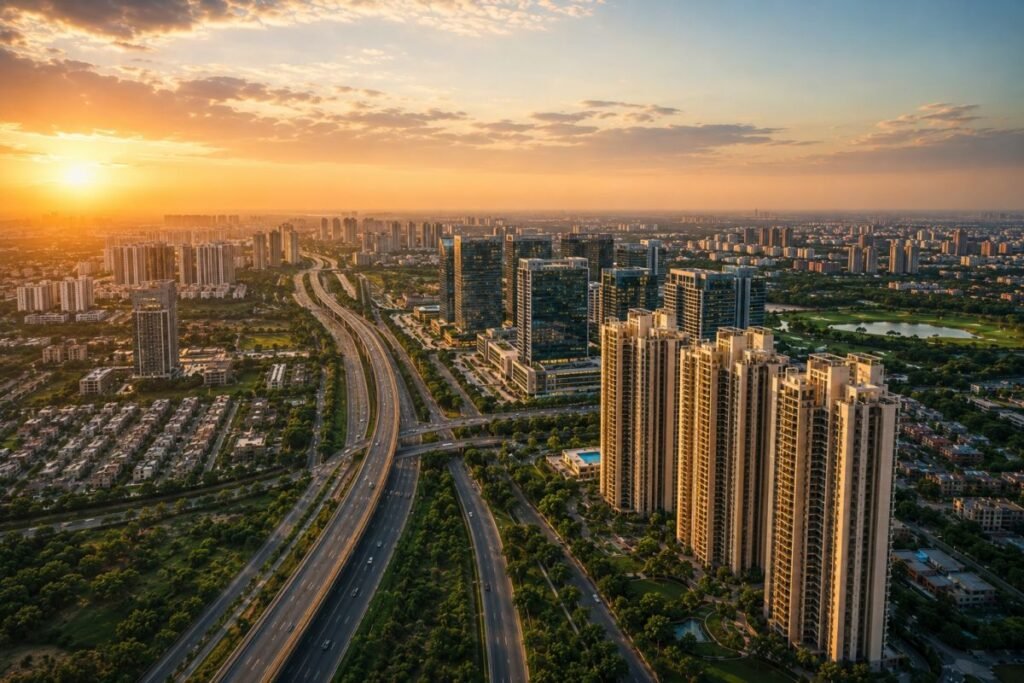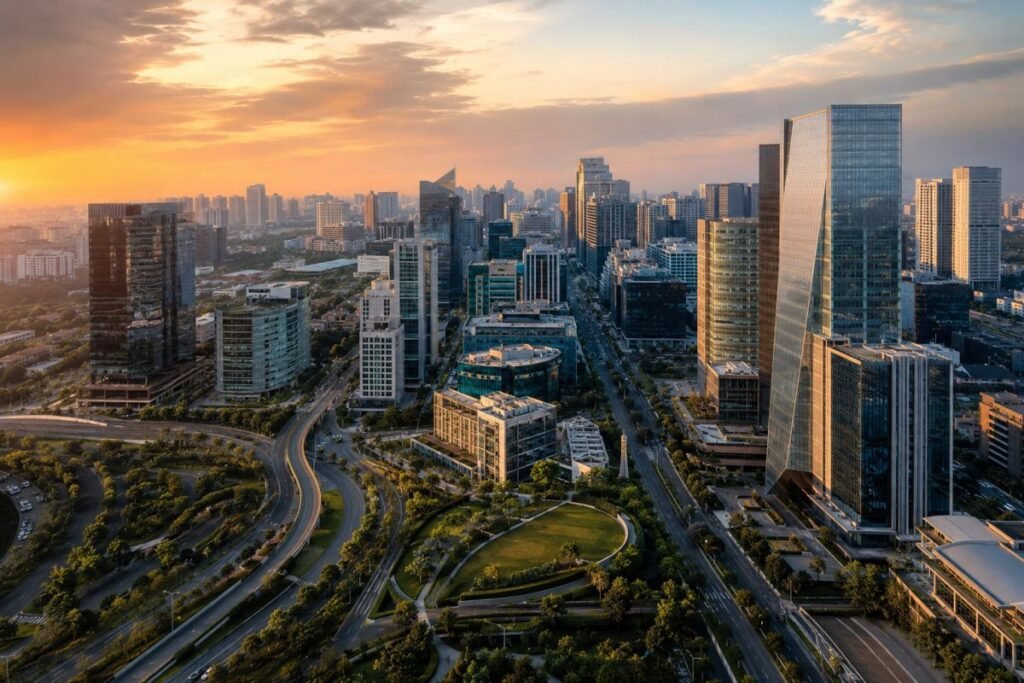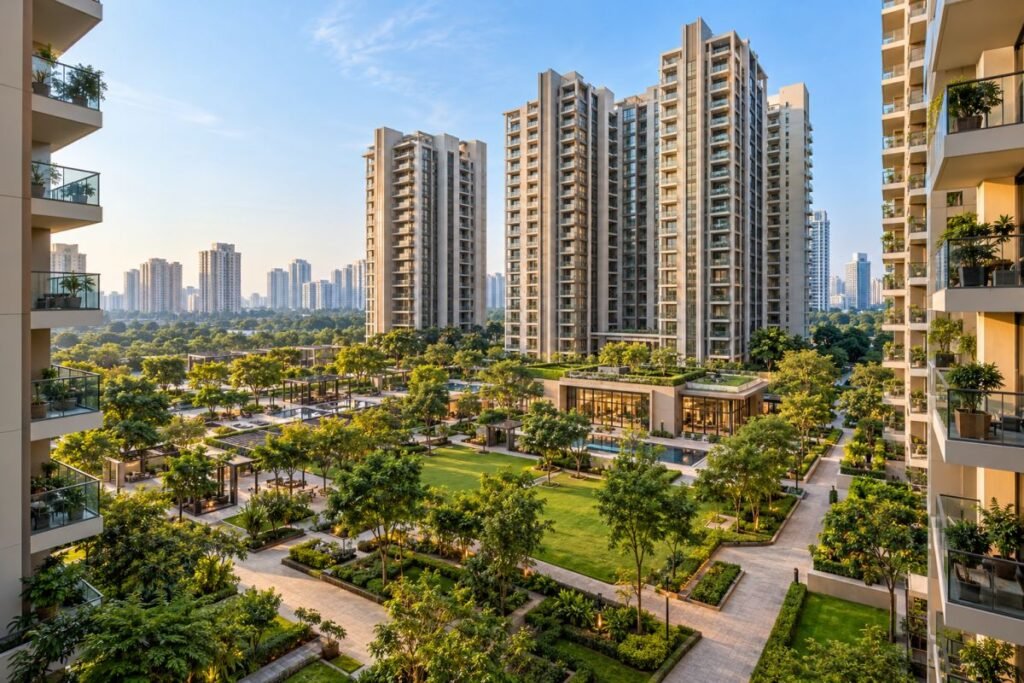
Green & Sustainable properties in Gurugram are becoming an important consideration for homebuyers and investors who want more than modern architecture, premium amenities and an attractive location. With rising temperatures, increasing pressure on urban water supplies, air-quality concerns and the long-term cost of maintaining high-rise communities, a property’s environmental performance can influence both its everyday livability and its investment appeal.
However, a building marketed as green is not automatically energy-efficient, water-secure or inexpensive to maintain. The real value depends on how the property has been designed, which systems have actually been installed, how effectively the community manages its resources and whether the benefits can be verified.
For buyers evaluating residential developments along Dwarka Expressway, Golf Course Extension Road, Southern Peripheral Road (SPR) and New Gurugram, sustainability should be part of the property due-diligence process rather than an optional lifestyle consideration.
This guide explains what makes a property sustainable, which features deserve scrutiny, how green credentials can influence investment decisions and what to verify before committing your money.
What Are Sustainable Properties in Gurugram?
Sustainable properties are residential buildings or communities designed and operated to use resources efficiently, reduce environmental impact and provide a healthier, more comfortable living environment.
In practical terms, this means looking beyond landscaped gardens and rooftop solar panels. A genuinely sustainable residential development considers the entire building lifecycle, from site selection and construction materials to water consumption, electricity demand, waste management and long-term maintenance.
Key characteristics include:
- Energy efficiency: Better building orientation, effective insulation, efficient lighting and appropriately designed ventilation systems.
- Water conservation: Rainwater harvesting, low-flow fixtures, wastewater treatment and the reuse of treated water.
- Indoor environmental quality: Adequate daylight, ventilation, moisture control and suitable construction materials.
- Sustainable landscaping: Native or climate-appropriate plants, efficient irrigation and reduced dependence on water-intensive lawns.
- Responsible waste management: Segregation, recycling and effective treatment of organic waste.
- Efficient mobility: Convenient access to public transport, pedestrian routes and essential daily services.
A property does not need every possible technology to be sustainable. The important question is whether its features deliver measurable benefits and remain operational after residents move in.
Why Green & Sustainable Properties in Gurugram Matter
Gurugram’s property market includes premium high-rise apartments, gated communities, independent floors and large integrated developments. Their environmental performance can differ substantially, even when they occupy similar price segments.
Three local considerations make sustainability particularly relevant.

1. Heat and electricity consumption
Gurugram experiences hot summers, making cooling an important part of residential electricity consumption. Apartments with suitable orientation, effective shading, efficient glazing and well-designed building envelopes may require less mechanical cooling than comparable homes with poor thermal performance.
For buyers, the practical benefit is not simply a green label. It is the possibility of improved indoor comfort and lower electricity consumption under comparable occupancy and weather conditions.
2. Water security
Water management deserves particular attention in high-density residential communities. Large populations, landscaped common areas, swimming pools and shared facilities create continuing demand for water.
Rainwater harvesting, functioning sewage treatment plants (STPs), treated wastewater reuse and water-efficient fixtures can help reduce dependence on freshwater supplies.
Yet the presence of an STP or rainwater harvesting structure does not prove that a development is water-efficient. Buyers should examine operational records, treatment capacity, maintenance arrangements and the actual use of recycled water.
3. Long-term operating costs
A property’s purchase price is only one component of ownership cost. Electricity for common areas, water procurement, pumping, cooling, landscaping and equipment maintenance can influence recurring expenditure.
Efficient systems may reduce some of these costs, but they also require appropriate maintenance and periodic replacement. The strongest investment case comes from verified operational performance rather than assumptions about future savings.
Which Green Features Should Buyers Evaluate?
Not every environmental feature deserves equal weight. The following comparison helps distinguish practical benefits from features that may have limited value if poorly implemented.
| Green feature | Potential benefit | What buyers should verify |
|---|---|---|
| Rooftop solar power | Can offset part of common-area electricity demand | Installed capacity, actual generation and allocation of savings |
| Rainwater harvesting | Can support groundwater recharge where properly designed | System condition, recharge arrangements and maintenance records |
| Sewage treatment plant | Enables wastewater treatment and potential reuse | Capacity, operating records, treatment quality and reuse network |
| Energy-efficient lighting | Can reduce common-area electricity consumption | LED coverage, controls and electricity bills |
| Efficient building envelope | May reduce cooling demand and improve comfort | Orientation, shading, glazing and thermal design |
| Water-efficient fixtures | Can reduce household water consumption | Fixture specifications and actual flow rates |
| Sustainable landscaping | Can lower irrigation demand | Plant selection, irrigation methods and maintenance practices |
| Waste segregation | Supports recycling and better waste handling | Collection procedures, segregation compliance and disposal arrangements |
The objective is to assess whether these features are functional, appropriately designed and economically useful.
Does green building certification matter?
Certification can provide a structured way to evaluate environmental performance. Residential rating systems assess categories such as site planning, energy efficiency, water conservation, materials, indoor environmental quality and resource management.

A project may hold a preliminary rating or pre-certification before receiving its final certification. These are not equivalent. Buyers should confirm the exact project, rating level, certification status, validity and scope of the assessment.
Certification is a useful starting point, not a substitute for checking construction quality, legal approvals, maintenance arrangements or actual operating performance.
How to Assess Sustainable Properties Across Gurugram’s Main Corridors
Location and building efficiency should be evaluated together. A well-designed apartment may still create a high household transport footprint if essential services are distant or residents must depend on private vehicles for every journey.
Dwarka Expressway
Dwarka Expressway attracts buyers considering modern residential communities and access towards Delhi and IGI Airport. When evaluating a project here, assess the building’s energy and water systems alongside road access, public transport connectivity, nearby services and the practical distance to daily destinations.
Do not assume that a newly developed community is sustainable simply because it has modern construction or extensive landscaping. Check whether the promised infrastructure is operational and whether the project provides documented environmental performance.
Golf Course Extension Road
This corridor has established residential catchments, premium apartment developments and access to commercial facilities. Buyers should compare efficient building design, water reuse, common-area electricity consumption and the quality of facilities management across competing developments.
For investors, the relevant question is whether sustainability improves the property’s overall ownership proposition without requiring a disproportionate purchase-price premium.
Southern Peripheral Road (SPR)
SPR combines residential development with access to employment, retail and other urban facilities. Here, buyers should examine both the environmental performance of the individual development and the infrastructure surrounding it.
Future connectivity plans should not be treated as completed infrastructure. Evaluate the current commuting experience, available public transport and dependence on private vehicles before assigning value to anticipated improvements.
New Gurugram
New Gurugram includes developing residential clusters where master planning, open spaces and newer building systems may be important differentiators.
Buyers should pay particular attention to water sourcing, drainage, waste handling, access to daily necessities and the maturity of local infrastructure. A landscaped master plan is less valuable if water availability, road access or essential services remain inconsistent.
Do Sustainable Properties Offer Better Investment Potential?
Sustainability can support an investment case, but it does not independently guarantee capital appreciation, rental growth or superior resale liquidity.
Its investment value usually comes through several possible channels.
Lower operating expenditure: Efficient energy and water systems may reduce recurring costs, provided their performance is documented and maintenance remains effective.
Tenant appeal: Some tenants may prefer homes with better thermal comfort, reliable services and manageable utility bills. Whether this produces a rental premium depends on the local market and competing supply.
Resale differentiation: Verifiable efficiency measures can help a property stand out against comparable homes. The strength of this advantage depends on buyer awareness, the quality of the development and the property’s overall condition.
Reduced operational risk: Reliable water reuse, energy management and preventive maintenance may make a community less exposed to certain resource-related disruptions.
These benefits must be weighed against the initial price, maintenance charges, location, developer execution and future repair costs.
Calculate the total cost of ownership
Consider the following before paying a premium for a green property:
- Purchase price and applicable transaction charges.
- Monthly maintenance and common-area utility costs.
- Household electricity and water expenses.
- Additional charges for specialised systems or equipment.
- Expected repair, replacement and maintenance requirements.
- Potential rental income and resale demand.
A sustainable property that costs significantly more upfront may not be the better investment if its operating savings are small or difficult to verify.
For a more meaningful comparison, request actual utility and maintenance records from occupied communities with similar apartment sizes, occupancy levels and amenities. Compare like with like rather than relying on advertised savings.
Green Properties vs Conventional Properties: Which Is Better?
| Decision factor | Sustainable property | Conventional property |
|---|---|---|
| Initial price | May carry a premium, depending on design and positioning | May be lower or higher depending on location and quality |
| Electricity use | Potentially lower with effective design and systems | Depends on the building’s design and equipment |
| Water consumption | Can be lower with efficient fixtures and reuse | Depends on supply arrangements and water management |
| Maintenance | May involve specialised equipment and service contracts | Depends on common facilities and building systems |
| Indoor comfort | Can improve with appropriate daylight, shading and ventilation | Depends on construction and apartment design |
| Resale prospects | Green credentials may help differentiate the property | Location, condition, pricing and demand remain decisive |
| Investment suitability | Stronger when savings and performance are verifiable | Can be preferable when acquisition cost and fundamentals are superior |
Neither category is automatically the better investment. A well-maintained conventional apartment in a strong location can outperform an inefficiently managed green-certified development.
The right comparison is between specific properties, not labels.
What to Check Before Buying a Sustainable Property
Before paying a premium, ask the developer or residents’ association for evidence that the advertised features exist and work as intended.
1. Verify the environmental claims
Ask for the exact certification name, rating level and current status. Where certification is claimed, request supporting documentation and distinguish preliminary recognition from final certification.
Check the scope carefully. A rating for a building or phase should not automatically be assumed to cover every tower or facility in a larger development.
2. Examine water infrastructure
Confirm whether the rainwater harvesting system and STP are operational. Ask how treated wastewater is reused, which areas receive it and who is responsible for maintenance.
For occupied projects, request water consumption records, tanker procurement information where available and evidence of recurring system maintenance.
3. Review electricity performance
Ask whether solar installations serve apartments, common areas or both. Request generation records where available and establish how any savings are allocated.
For existing properties, common-area electricity bills can provide useful context, although differences in occupancy, facilities and weather must be considered.
4. Understand maintenance obligations
Efficient systems require regular servicing. Review maintenance charges, equipment warranties, service contracts, replacement responsibilities and the financial arrangements for major repairs.
A poorly maintained green system may deliver little benefit despite a strong original specification.
5. Check legal and project documentation
Review the agreement for sale, approved plans, applicable occupancy or completion documentation and the relevant project registration details where required.
Confirm that advertised sustainability features are consistent with the relevant contractual and approved project documents. Do not treat a green certification as proof of RERA compliance or legal title.
6. Evaluate the surrounding neighbourhood
Examine actual access to workplaces, schools, healthcare, public transport and daily retail. Walkability and shorter routine journeys can improve convenience and reduce transport dependence.
Also assess road conditions, drainage, construction activity and the availability of essential services. Sustainability inside the boundary cannot compensate for every weakness outside it.
Common Mistakes to Avoid When Buying a Green Home
Even informed buyers can overestimate the value of sustainability features when evaluating a premium residential property.
- Paying for marketing instead of performance: A brochure may describe solar power, green landscaping and water recycling without showing whether these systems operate effectively.
- Confusing pre-certification with final certification: Verify the current status and scope rather than relying on a sales presentation.
- Ignoring maintenance costs: Specialised equipment can require trained operators, periodic servicing and eventual replacement.
- Assuming green means premium resale: Buyers may value efficiency, but location, apartment condition, pricing and market liquidity still influence the transaction.
- Overlooking water dependence: A wastewater treatment system does not automatically eliminate dependence on external water supplies.
- Ignoring construction and legal quality: Sustainability should complement, not replace, structural due diligence, title checks and applicable regulatory compliance.
For under-construction properties, review the contractual specifications and completion obligations. For ready-to-move homes, prioritise actual operating records and an inspection of the installed systems.
Are Sustainable Properties Worth the Extra Cost?
The answer depends on the price premium, measurable savings, expected holding period and quality of execution.
Suppose two comparable apartments offer similar locations, usable space and facilities. One has demonstrably lower utility consumption, reliable water-reuse infrastructure and a well-managed maintenance system. The more efficient apartment may offer better long-term value if the additional acquisition cost is reasonable.
However, the financial advantage must be calculated rather than assumed.
A practical approach is to compare the annual operating-cost difference against the extra purchase price. Include maintenance charges and likely equipment-replacement expenses, and use actual records wherever possible. Avoid projecting savings that the developer cannot substantiate.
For investors with a long holding horizon, sustainability can form part of a broader strategy focused on property quality, tenant appeal and operational resilience. For end-users, improved comfort and reliable essential services may be valuable even when the direct financial return is modest.
The most defensible purchase is one in which the environmental features, the location and the economics all support the decision independently.
The AssetBulls Verdict
Sustainable properties in Gurugram deserve consideration as part of a disciplined property-buying strategy, but buyers should distinguish measurable performance from attractive marketing.
Prioritise three things: verified efficiency, dependable operations and sound property fundamentals. Evaluate water management carefully, compare energy consumption wherever reliable data exists, and understand the cost of maintaining specialised systems over the ownership period.

When comparing developments along Dwarka Expressway, Golf Course Extension Road, SPR and New Gurugram, assess the surrounding infrastructure alongside the building itself. The strongest option is not necessarily the one with the longest list of green features; it is the one that delivers practical benefits without compromising location, affordability or long-term maintainability.
Explore relevant property and sector listings on AssetBulls.com or speak to the advisory team to compare residential options against your budget, intended holding period and ownership priorities.
Frequently Asked Questions About Sustainable Properties in Gurugram
1. What are sustainable properties in Gurugram?
Sustainable properties in Gurugram are homes designed or operated to reduce energy and water consumption, manage waste responsibly and support comfortable indoor living. Features may include solar power, rainwater harvesting, treated wastewater reuse, efficient lighting and climate-responsive building design.
2. Are green-certified properties in Gurugram worth buying?
They can be worth buying when certification is verified and the property’s environmental features provide practical benefits. Buyers should compare the purchase price, maintenance costs, actual resource consumption, location and resale prospects rather than assuming certification guarantees better returns.
3. Do sustainable apartments reduce electricity and water bills?
They can reduce consumption through efficient cooling, lighting, water fixtures and wastewater reuse. Actual savings depend on the building design, occupancy, equipment performance, local conditions and maintenance. Buyers should request operating records instead of relying exclusively on estimated savings.
4. Which areas in Gurugram should I consider for sustainable residential properties?
Dwarka Expressway, Golf Course Extension Road, SPR and New Gurugram are worth evaluating for residential options. The best choice depends on the individual project’s environmental performance, transport access, water infrastructure, total ownership cost and proximity to everyday services.
5. How can I verify whether a residential project is genuinely sustainable?
Request the exact green-building certification and its current status, inspect the project’s energy and water systems, and review operating records where available. Also check the relevant Haryana RERA registration, approved project documents, applicable completion or occupancy documentation and maintenance arrangements. A sustainability label alone is not sufficient proof of overall property quality.